Memorandum to the President
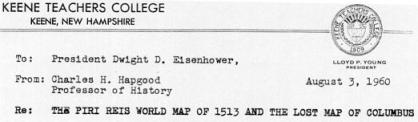
Memorandum
For several centuries scholars have been searching for the lost map of Christopher Columbus. The map is referred to by Columbus’ contemporaries and by the historian Las Cada, as one he used to navigate to the New World.
In 1929 a map was discovered in the former Imperial Palace (The Seraglio) in Constantinople, authored by a Turkish admiral of the 16th Century, Piri Reis. In the inscriptions written on this map the author states that the western part, showing the American coasts, was copied from a map that had been in the possession of Christopher Columbus, but which had fallen into the hands of Piri Reis with the booty seized from eight Spanish ships captured by him in a battle off the coast of Valencia in 1501 or 1508.
The Piri Reis map (a copy of which accompanies this memorandum) attracted the attention of President Kemal Ataturk, and of the American Secretary of State, Henry Stimson, who, in 1932, asked the Turkish Government for a color facsimile of the map, and for a search of Turkish archives and collections to see if the lost map of Columbus might not be found. The facsimile of the map now hangs in the Map Division of the Library of Congress, but the original Piri Reis worked from – Columbus’ own map (or a copy of it) – was never found.
We now have excellent reason to believe that the original map still exists, and in the Spanish archives! The reason that this map has remained so long undiscovered appears to be, simply, that it is very different from the other contemporary maps and is not at all what scholars would expect to find in a map of Columbus. It is not a map Columbus himself made, but one he found in the Old World. It should resemble the western side of the Piri Reis map, if it can be found.
Evidence of its present whereabouts came to me through my old friend and scientific collaborator, James H. Campbell, who, together with his father, a professional geographer, actually saw this map in 1893. I am enclosing a separate account of this incident in Mr. Campbell’s own words. It seems that in 1893, at the time of the Columbian Exposition in Chicago, the Spanish Government built and sent to America replicas of Columbus’ three ships. The caravels were sailed across the Atlantic and through the Great Lakes to Chicago. It was there that Mr. Campbell and his father were invited, as he describes in detail, to see Columbus’ own map in the chart room of the Santa Maria. In addition to the important purpose of clearing up many mysteries relating to the Discovery of America, we have another purpose in asking that a search be made for the map now. Studies of the map by various scholars have shown that it contains many details that were not known to the geographers in 1513. These indicate that the map must descend from maps made in very ancient times, and that navigators (possibly of Phoenician origin) discovered and explored the coasts of America, perhaps a millennium before the Christian era. This, of course, tends to give support to the tradition that Columbus brought a map from the Old World. It seems that Columbus left the Old World with quite a good map of America in his pocket!
The most remarkable detail of the Piri Reis map indicating its enormous age was pointed out by Captain Arlington Mallery some years ago. He stated that the lower part of the map showed the sub-glacial topography of Queen Maud Land, Antarctica, and the Palmer Peninsula. After four years of study of the map we came to recognize that Captain Mallery’s statement was correct, but, desiring the most authoritative checking of our conclusions, we submitted the data to the cartographic staff of the Strategic Air Command. I attach a letter from Col. Harold Z. Ohlmeyer, Commander of the 8th Reconnaissance Technical Squadron, SAC, in confirmation. Needless to say this is a matter of enormous importance for cartography and for history. The Antarctic ice cap is at present one mile thick over the areas shown on the Piri Reis Map. Consultations with geological specialists have indicated beyond question the truth that the data on the map is many thousands of years old. It seems that the Antarctic ice cap covered the Queen Maud Land coast not later than 6,000 years ago. The map information must have been obtained earlier by the Phoenicians or by some earlier (and unknown) people.
If the Columbus map can now be found we shall learn whether it contained the Antarctic data, or whether Piri Reis used another source map. If the Columbus map did contain the data, then we will know he found the map in Europe, and that therefore he had a good idea of where he was going.
The most important step at the present time is to push the search in Spain for the map that was on the replica of the Santa Maria during the summer of 1893. Success in this search will make it possible to rewrite in a fundamental way, the history of the Discovery of America.
Very sincerely yours,
Charles H. Hapgood
Keene Teachers College
This is an excerpt from the new, 2009, updated edition of When the Sky Fell: Atlantis in Antarctica.
To read a FREE sample, with more about Charles Hapgood’s correspondence with the President, please follow this easy 2-step process:
- STEP 1: Download a
- STEP 2: Go to
Also available as a .
Enjoy.


